
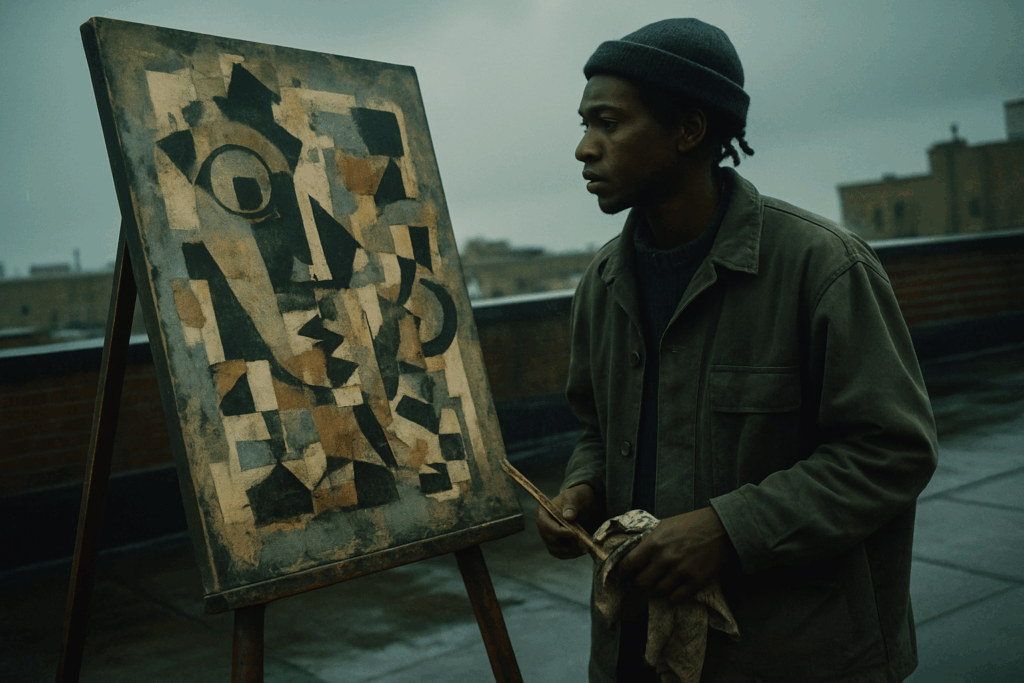
Where Dadaism Came From
Dadaism didn’t come from art schools or museums. It came from war. World War I had just torn Europe apart. The old ideals logic, progress, nationalism had led to trenches, destruction, and millions dead. For a group of artists and writers scattered across Zurich, New York, Berlin, and beyond, the only honest response was to throw out tradition entirely. Art, they believed, had to be just as chaotic and absurd as the world around them.
So, they made noise. Literal and figurative. They mocked reason, rules, and polite society. They glued together nonsense, performed gibberish poetry, turned toilets into sculptures, and called it art. Not because they were trying to make something beautiful they weren’t. They were flipping the entire system the bird. If the world made no sense, why should art?
In rejecting classical forms and highbrow elitism, Dada launched a full on revolt. At its core, Dadaism was anti art. Not because it hated creativity, but because it wanted to destroy the corrupt structures that defined what art was supposed to be. For them, creation was protest.
How Dada Shook the Foundation of Art
Dada didn’t follow rules it shredded them. In the wake of World War I, artists behind the movement didn’t just reject tradition; they laughed at it. Paint by numbers? No thanks. Instead, Dadaists embraced chaos, putting forward the idea that if order led to war, maybe disorder could shake people awake.
At the center of this was Duchamp’s urinal officially titled “Fountain” a factory made object submitted as art. With that single act, the message was clear: art isn’t about paint strokes or marble carvings. It’s about intent. The object became the message. The gallery had to adjust, not the other way around.
Performance, gibberish poetry, typo riddled manifestos Dada gave space to everything the elites sneered at. Nonsense wasn’t a mistake; it was the point. If society was broken, then sense might not be the best lens through which to look at it. In offering absurdity and contradiction, Dada cracked open new creative territory, and invited others to stop asking permission.
Dada’s Footprint in Modern Movements

Dada may have looked chaotic on the surface, but beneath the nonsense was a blueprint for reshaping what art could be. The movement opened the door for Surrealism’s dream logic, Pop Art’s collision of mass and culture, and the stripped down brain games of conceptual art. It rewired the purpose of the work from object to idea.
What mattered most to Dadaists wasn’t some polished final product. It was everything that came before that: the provocation, the performative act, the curation of absurdity. That mindset lingers. You can see it clearly in how today’s creators across mediums focus on iterations, process shots, and behind the scenes honesty. The art is often secondary to the way it took shape.
Look carefully and the echoes are everywhere. In the unsanctioned poetry of street art, the unpredictable noise of glitch aesthetics, and the remix heavy world of digital media. Dada’s spirit lives on not as a style, but as a permission do it your way, break the format, make it matter.
The Influence on Contemporary Creative Thinking
Dadaism didn’t just disrupt it invited everyone to break the rules. The movement’s core was risk: shocking formats, absurd messages, and raw anti elitism. By mocking the art world’s gatekeepers and standards, Dada cracked open a space where ideas mattered more than polish, and where contradiction itself became a statement.
This mindset aligns neatly with today’s meme culture and protest art. Quick, rough, and unapologetic creativity often speaks louder than something refined. From viral image macros to satirical TikToks, there’s a throughline back to Dada’s no rules approach. Art today isn’t confined to galleries it happens on sidewalks, in live streams, and across comment threads.
More than anything, Dada expanded who gets to make art. You don’t need a degree or a collector’s blessing. If it sparks thought or questions norms, it counts. That same ethos drives many modern creators, especially those using humor, shock, and low fi formats to challenge the status quo. It’s not just about making something pretty. It’s about making something that punches.
Dadaism and the Shift in Visual Documentation
Dada emerged at the tipping point between worlds one hand gripped the paintbrush, the other flicked on the camera. Artists were starting to wrestle with the rise of mechanical reproduction, and it shaped their work in unpredictable ways. The Dadaists didn’t just notice the shift they leaned into it, poked fun at it, and dismantled what it meant to make something “authentic” by hand.
The tension was real. Traditional, handcrafted techniques carried the weight of history and intention. But as photography gained ground, so did the idea that you could capture reality instantly, without interpretation or so it seemed. Dada exposed the lie. They showed that even photos could be manipulated, recontextualized, or stripped of meaning. In doing so, they laid the groundwork for modern media literacy, collage culture, and even the meme as commentary.
Many Dada works were visual precursors to how we handle images today: sampled, duplicated, distorted. Artists like Hannah Höch and Raoul Hausmann cut up existing photographs and print material, stitching together compositions that looked mechanical but burned with message. This wasn’t nostalgia. It was transformation.
For deeper background, check this out: photography in art history.
Why Dada Still Matters
Dada didn’t fade. It morphed. The rebellion that once shocked salons became the groundwork for what art looks like now raw, rule breaking, and unafraid to provoke. By rejecting neat categories, it opened the floodgates for new forms. What we call avant garde today owes much to Dada’s blunt refusal to play by the old rules.
From glitch edits to TikTok surrealism, from activist posters to experimental zines, Dada’s fingerprints are all over modern visual culture. It left behind more than collages it left a mindset. A conviction that subversion isn’t destruction, but construction through a different lens. When creators hijack formats or shift meaning through humor or chaos, they’re using tools Dada sharpened a century ago.
Still today, art that disrupts or confuses carries power. In a world drowned in content, disruption wakes people up. Dada showed us that beauty doesn’t require polish, meaning doesn’t require clarity, and sometimes the mess is more honest than the masterpiece.
 There is a specific skill involved in explaining something clearly — one that is completely separate from actually knowing the subject. Stepheno Yatesingers has both. They has spent years working with art exhibitions and reviews in a hands-on capacity, and an equal amount of time figuring out how to translate that experience into writing that people with different backgrounds can actually absorb and use.
Stepheno tends to approach complex subjects — Art Exhibitions and Reviews, Art Movement Highlights, Creative Project Ideas being good examples — by starting with what the reader already knows, then building outward from there rather than dropping them in the deep end. It sounds like a small thing. In practice it makes a significant difference in whether someone finishes the article or abandons it halfway through. They is also good at knowing when to stop — a surprisingly underrated skill. Some writers bury useful information under so many caveats and qualifications that the point disappears. Stepheno knows where the point is and gets there without too many detours.
The practical effect of all this is that people who read Stepheno's work tend to come away actually capable of doing something with it. Not just vaguely informed — actually capable. For a writer working in art exhibitions and reviews, that is probably the best possible outcome, and it's the standard Stepheno holds they's own work to.
There is a specific skill involved in explaining something clearly — one that is completely separate from actually knowing the subject. Stepheno Yatesingers has both. They has spent years working with art exhibitions and reviews in a hands-on capacity, and an equal amount of time figuring out how to translate that experience into writing that people with different backgrounds can actually absorb and use.
Stepheno tends to approach complex subjects — Art Exhibitions and Reviews, Art Movement Highlights, Creative Project Ideas being good examples — by starting with what the reader already knows, then building outward from there rather than dropping them in the deep end. It sounds like a small thing. In practice it makes a significant difference in whether someone finishes the article or abandons it halfway through. They is also good at knowing when to stop — a surprisingly underrated skill. Some writers bury useful information under so many caveats and qualifications that the point disappears. Stepheno knows where the point is and gets there without too many detours.
The practical effect of all this is that people who read Stepheno's work tend to come away actually capable of doing something with it. Not just vaguely informed — actually capable. For a writer working in art exhibitions and reviews, that is probably the best possible outcome, and it's the standard Stepheno holds they's own work to.