
Breaking the Frame: Kusama’s Radical Approach
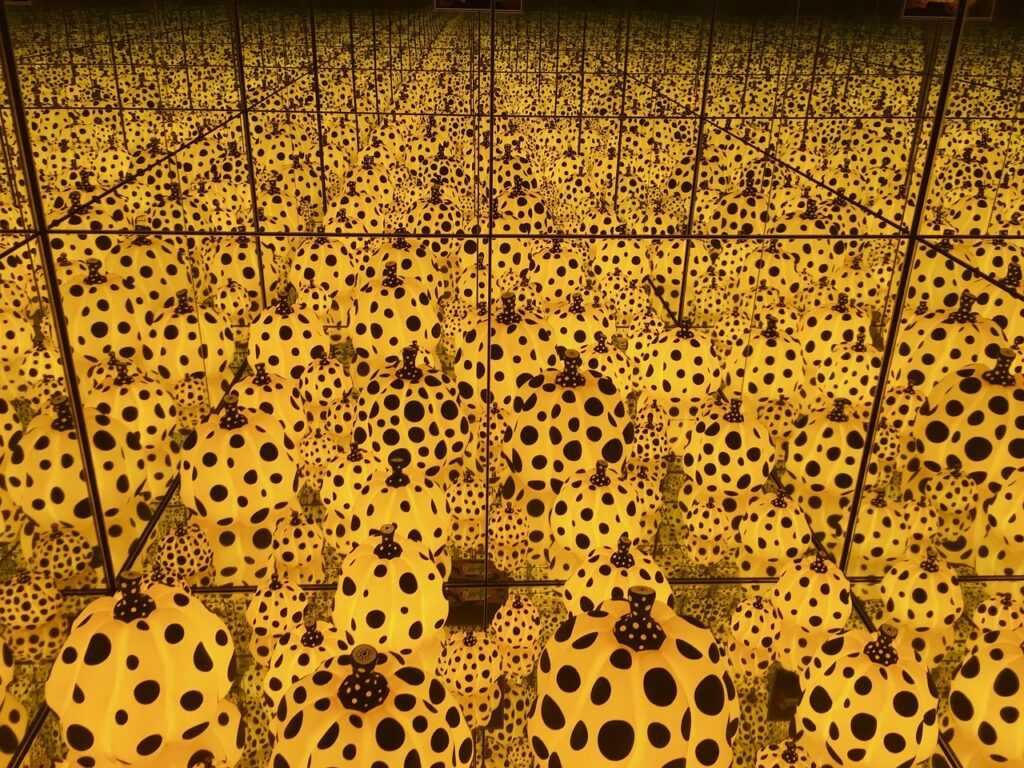
Yayoi Kusama’s work doesn’t sit quietly on a wall. It doesn’t wait for interpretation. It pulls you in sometimes literally. Her installations are designed to wipe out the distance between viewer and art, breaking down the traditional format of observation and turning it into full body experience. The usual gallery rules don’t apply. There’s no standing back, no passive viewing you’re in it or you’re missing it.
What makes Kusama different is how she shifts the room’s role from backdrop to participant. Her infinity rooms, pumpkin fields, and mirrored environments aren’t meant to be looked at they’re built to swallow you whole. Walls turn into portals. Light patterns rewire perception. With repetition and boundless scale, her spaces overwhelm the senses until your own sense of space and time starts to slide. That’s intentional.
But immersion here isn’t empty spectacle. There’s purpose behind the flood. Kusama turns scale and repetition into emotion calm, anxiety, awe, sometimes all at once. By dissolving physical boundaries, she also pokes at personal ones. You start to feel part of something endless, and for a moment, your individual self recedes. Whether you’re surrounded by dots, mirrors, or floating lanterns, it’s not just visual. It’s visceral. You don’t just see Kusama’s art. You feel it.
Infinity as a Mirror of the Mind
Step into one of Yayoi Kusama’s Infinity Rooms, and you’re not just stepping into a piece of art you’re stepping into her mind. The mirrors, the endless dots, the soft sculptures they aren’t random. They’re deliberate, obsessive, and deeply personal tools for saying what words can’t.
Repetition and reflection are more than design choices they’re modes of survival. Kusama uses them to process her own mental health struggles. The infinite reflections mirror states of dissociation and depersonalization, turning the room into a diary she invites the world to read. Each loop, each echo, reflects identity as something fragile and fluid, constantly reshaped in a space without edges.
Philosophically, her work confronts the idea of nothingness that in infinity, the self dissolves. But it’s not bleak. For Kusama, this dissolution is freeing. It makes room for something beyond ego. An erasure that’s actually a form of healing.
Kusama’s installations don’t just represent her inner world they give others a space to encounter their own. In the repetition, reflection, and quiet overwhelm, visitors often find themselves unmoored, but strangely seen. Art as therapy. Art as transcendence.
Explore deeper: Kusama’s Infinity Rooms
The Role of the Viewer
You’re Not Just Observing You’re Inside the Artwork
Yayoi Kusama’s installations challenge the conventional boundaries between art and audience. Entering one of her rooms isn’t passive viewing; it’s stepping into a constructed universe. Mirrors multiply your presence. Dots and lights dance around you. The result? You become part of the composition.
Kusama’s work doesn’t just invite you in it needs you there to be complete
Your reflection, movement, even breath, help activate the space
Viewers shift from spectators to participants
A Personal Mirror and Space for Stillness
While enveloping, Kusama’s art is not chaotic. In fact, her spaces often prompt a surprising sense of calm. The endless reflections and rhythmic patterns offer a moment of introspection in an overstimulated world.
The mirrored rooms invite silence, slowness, and thought
Colors and repetition draw viewers inward, encouraging mindfulness
Visitors often describe the experience as therapeutic or meditative
Ahead of the Curve: Participatory Art Before It Was a Trend
Long before social platforms made “immersive” buzzworthy, Kusama created environments that demanded interaction. Her work predicted a cultural shift from consuming art at a distance to experiencing it up close, in person, and on your own terms.
Kusama pioneered interactive spaces before digital virality
Her art inspired generations of installation artists exploring audience participation
Her influence echoes in today’s museums and exhibitions centered on immersive storytelling
Beyond Aesthetic: Cultural and Contemporary Impact
Kusama doesn’t just make art you look at she creates worlds you step into. That shift from viewer to participant has left a deep mark on a new wave of artists. You can see her influence in the explosion of experiential art spaces think mirrored illusions, saturated colors, and small rooms that feel like alternate realities. The difference? Kusama was doing it decades ago, and she didn’t need a hashtag army to sell tickets.
It still pulls crowds. Her exhibitions break attendance records in cities from Tokyo to São Paulo. The demand crosses age and genre lines. Whether it’s major retrospectives or Instagram famous Infinity Rooms, the pull isn’t hype it’s human. People line up not just for the photo, but for the feeling. And in Kusama’s worlds, feeling comes first.
That’s where she stands apart. While many installations today are designed to go viral, Kusama’s work goes deeper. Her signature repetition and mirrored spaces invite reflection, not just reaction. Visitors might take the selfie but they also stay a moment longer. Her art makes people pause. And in a landscape full of flash, that kind of stillness is rare and powerful.
Looking Into the Infinite
Yayoi Kusama didn’t just make art you enter it. That mindset is now the blueprint for the future of installation work. Her legacy shows that audiences don’t just want to view, they want to feel, move, and exist inside the art. As museums rush to stay relevant in a digital first world, Kusama’s immersive design turns attention spans into full body experiences.
What comes next builds on what she started. Artists are combining sensory feedback, AR/VR, and reactive soundscapes into physical spaces. The goal? To turn each visitor into a main character inside a moment that can’t be repeated. The line between exhibition and experiential narrative is blurring.
But tech alone isn’t the answer it’s how it’s used to tell stories that matter. Kusama’s work hits because it’s not just visual candy. It tackles the self, the infinite, isolation, repetition. So as others ramp up the visual overload, the ones who push meaning through the noise will lead.
Her legacy proves that immersion isn’t just spectacle it’s storytelling turned inward. That’s where installation art is headed. Want more on how Kusama’s spaces still shape that journey? Read: Kusama’s Infinity Rooms.
 Trevana Kelthorne has opinions about essential techniques and tools. Informed ones, backed by real experience — but opinions nonetheless, and they doesn't try to disguise them as neutral observation. They thinks a lot of what gets written about Essential Techniques and Tools, Art Exhibitions and Reviews, Artist Spotlights is either too cautious to be useful or too confident to be credible, and they's work tends to sit deliberately in the space between those two failure modes.
Reading Trevana's pieces, you get the sense of someone who has thought about this stuff seriously and arrived at actual conclusions — not just collected a range of perspectives and declined to pick one. That can be uncomfortable when they lands on something you disagree with. It's also why the writing is worth engaging with. Trevana isn't interested in telling people what they want to hear. They is interested in telling them what they actually thinks, with enough reasoning behind it that you can push back if you want to. That kind of intellectual honesty is rarer than it should be.
What Trevana is best at is the moment when a familiar topic reveals something unexpected — when the conventional wisdom turns out to be slightly off, or when a small shift in framing changes everything. They finds those moments consistently, which is why they's work tends to generate real discussion rather than just passive agreement.
Trevana Kelthorne has opinions about essential techniques and tools. Informed ones, backed by real experience — but opinions nonetheless, and they doesn't try to disguise them as neutral observation. They thinks a lot of what gets written about Essential Techniques and Tools, Art Exhibitions and Reviews, Artist Spotlights is either too cautious to be useful or too confident to be credible, and they's work tends to sit deliberately in the space between those two failure modes.
Reading Trevana's pieces, you get the sense of someone who has thought about this stuff seriously and arrived at actual conclusions — not just collected a range of perspectives and declined to pick one. That can be uncomfortable when they lands on something you disagree with. It's also why the writing is worth engaging with. Trevana isn't interested in telling people what they want to hear. They is interested in telling them what they actually thinks, with enough reasoning behind it that you can push back if you want to. That kind of intellectual honesty is rarer than it should be.
What Trevana is best at is the moment when a familiar topic reveals something unexpected — when the conventional wisdom turns out to be slightly off, or when a small shift in framing changes everything. They finds those moments consistently, which is why they's work tends to generate real discussion rather than just passive agreement.